



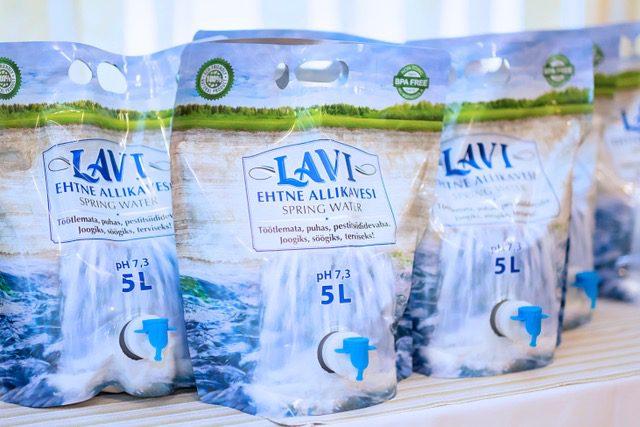
Lavi Pure Spring Water 5 L Untreated
15.80 € (3.16 €/l)
Buy more, save more
The Lavi village springs are located in Vinni parish, Lääne-Viru County, in the eastern part of the Pandivere Upland. The springs border the Männikvälja esker field, on whose slopes descending springs emerge. Depending on the season and the amount of precipitation, the total flow rate of the Lavi springs is 108–441 l/s. According to measurements, the flow rate of our spring is 20–30 l/s. The water temperature in the springs is stable all year round, at approximately 6 °C.
The Lavi springs are known as sources of pure water that people have been drinking since the Stone Age.
The Lavi springs are located above vertical fissures of tectonic origin in the bedrock. The spring water comes to the surface from the Pakerort-Tiskre formation, which consists mainly of sandstone and siltstone – the upper part of the aquifer – and is slightly mixed with water from the Silurian-Ordovician aquifer complex. Here the good qualities of two aquifers meet: thanks to the depth, better protection than surface water, while the near-surface, spring-like character gives a favourable chemical composition – with no harmful impurities.
Naturally filtered by free flow – mineralised through limestone and purified through sandstone – the spring water contains a fair amount of calcium carbonates (lime, in everyday language) and other minerals in the combination provided by nature. Calcium is needed for the maintenance of normal bones.
Spring water with a natural composition containing calcium hydrogen carbonate may leave limescale in your coffee machine – but that is simply a sign of its natural mineral content!
Why spring water rather than treated borehole water?
Industrially treated drinking water and mains water, which has been purified through several processes and enriched with minerals if necessary, is quite different from natural water.
Historically, people have been used to drinking only water purified by nature. Treated water protects water pipes and household appliances and protects against bacterial contamination, but it is not the same as natural spring water with its natural mineral content.
Near-surface spring drinking water differs in its chemical composition from water from deeper layers. Groundwater in higher, aerobic (oxygen-containing) conditions and in the zone of faster water exchange has a low trace element content. It does not contain the harmful or excessive elements that may occur in deeper layers (barium, ferrous iron, hydrogen sulphide, radionuclides, ammonium ions, methane, boron, excess fluoride and dissolved salts); in higher layers the fluoride content is optimal. Long-term excessive consumption of mineral water with a high mineral content and a specific composition is not recommended, as high salinity and many trace elements can accumulate in the body.
When water from deeper layers is used as drinking water, it has to be treated: aerated, filtered and sometimes chemically treated. Sometimes, after aeration, strong chemical oxidants such as ozone (O3), chlorine (Cl2) or potassium permanganate (KMnO4) are used to ensure final oxidation. With spring water, this is not necessary.
Why is Lavi spring water packed in a bag rather than a bottle?
Lavi spring water is supplied in a 5-litre BPA-free vacuum pouch made of light-proof material suitable for storing water. The water is kept in the dark and comes out through a butterfly tap that does not let air back in. If you also keep the bag in a cool place – in the same conditions as the water underground – the water stays as fresh as possible and retains the pure taste typical of spring water.
Using pouches is more environmentally friendly than bottling, as the energy needed for packaging and transport is considerably lower. The bag itself can be refilled at home. At the end of its life, the bag material is recyclable.
Additional information
| Weight | 6.55 kg |
|---|---|
| Brand |


Reviews
There are no reviews yet.