



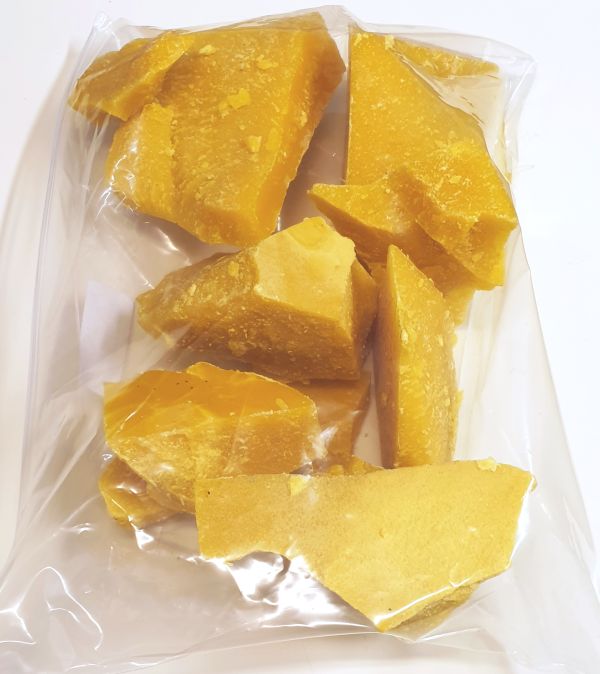
Beeswax 1 kg
39.90 €
Buy more, save more
South Estonia
Beeswax is used, among other things, to make candles, cosmetics, grafting wax, shoe polish and various finishing waxes.
Traditionally, beeswax has also been used for sealing containers.
Beeswax is secreted by the wax glands of young worker bees. Wax is the material bees use to build honeycombs.
To produce a kilogram of beeswax, bees must eat 7 kilos of nectar.
The wax glands are located on the third, fourth, fifth and sixth abdominal segments of worker bees. Each segment has two transparent wax mirrors. Beneath the wax mirrors are wax-secreting cells, which become bladder-like as the bee grows and fill with liquid wax. The wax passes through the chitin mirror to the surface and solidifies into a small flake.
Bees begin secreting wax at 3–5 days of age and stop when they become foragers at 18–20 days of age. Queen bees and drones have no wax glands.
At room temperature, wax is solid and hard, with a pleasant characteristic scent. Depending on the content of impurities (honey, propolis, pollen), the colour of the wax ranges from whitish to dark brown. Wax does not dissolve in water. The melting point of wax is 60…65°C. The density of beeswax is about 960 kg/m3.
Wax contains about 80% carbon, 13% hydrogen and 7% oxygen. A colony uses 3.5 kg of honey to secrete 1 kg of wax.
The food additive code for beeswax is E901.
Additional information
| Weight | 1.14 kg |
|---|





Reviews
There are no reviews yet.